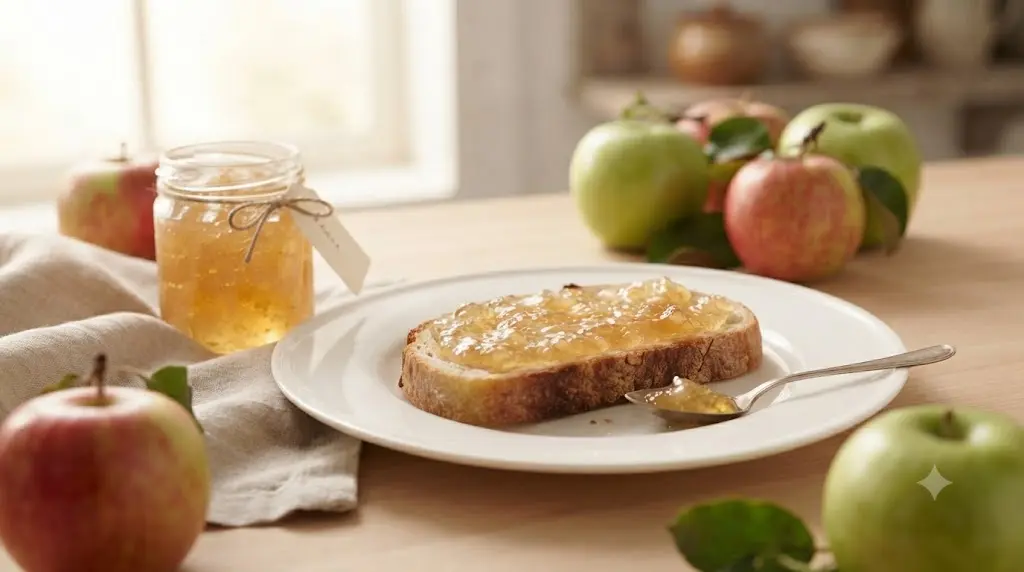
Homemade apple jelly is one of those recipes where a few simple ingredients can produce something surprisingly beautiful. Fresh apples are cooked until tender, their flavorful juice is slowly strained, and that clear juice is cooked with sugar until it reaches a delicate jelly consistency.
What makes this method special is that you do not have to start with a bottle of apple juice or depend entirely on commercial pectin. Apples naturally contain pectin, particularly in the skins and cores, so keeping those parts during the juice-making stage helps the jelly develop its characteristic set.
The key to good making apple jelly is patience. The apples need enough time to release their juice, but the strained liquid should be handled gently. If you press the cooked apple pulp too hard, tiny particles can pass into the juice and leave you with cloudy jelly.
This apple jelly recipe gives you a traditional, clear preserve with a fresh apple flavor that works beautifully on toast, biscuits, pancakes, waffles, and homemade bread.
Why This Apple Jelly Recipe Works
There are several small details that make a noticeable difference in the finished jelly.
The apples are not peeled or cored. The skins and cores contribute natural pectin, which is important when you are making jelly without commercial pectin.
A mixture of ripe and slightly underripe apples is useful. NCHFP recommends about three-fourths ripe fruit and one-fourth underripe fruit when relying on natural pectin.
The juice is allowed to drain naturally. This helps produce a clearer jelly than aggressively squeezing the cooked fruit.
The sugar is measured according to the amount of juice. This is much more reliable than guessing how much sugar to add based only on the number of apples.
The jelly is cooked to the correct endpoint. Temperature and the sheet test can both help determine when it is ready.
What Kind of Apples Are Best for Apple Jelly?
Tart, firm apples are especially useful for jelly, particularly when some of the apples are slightly underripe.
You do not have to use only one variety. A combination can give you a better balance of sweetness, acidity, apple flavor, and natural pectin.
For a natural-pectin version, avoid relying entirely on very ripe, soft apples. Fruit’s pectin characteristics change as it ripens, which can affect how well the jelly sets.
If your apples are very sweet, adding a little lemon juice can provide the acidity used in the tested recipe.
Do You Peel Apples for Jelly?
No. Leave the apples unpeeled.
For this type of apple jelly recipe, wash the apples well, remove damaged portions, cut them into pieces, and leave the skins and cores in place. The pectin is more concentrated in these areas, so removing them is unnecessary when you are extracting the juice first.
You will strain the cooked apples later, so there is no need to spend time peeling and coring every piece.
Ingredients for Apple Jelly
You only need a few ingredients:
- Fresh tart apples
- Water
- Granulated sugar
- Lemon juice, if desired
For the tested NCHFP apple jelly formula, about 3 pounds of apples and 3 cups of water produce approximately 4 cups of apple juice, followed by 3 cups of sugar and 2 tablespoons of strained lemon juice if desired. The yield is approximately 4 to 5 half-pint jars.
Ingredient Tip
Do not automatically add 3 cups of sugar simply because you used 3 pounds of apples.
First extract and measure your juice. The amount can vary slightly depending on the apples. For the tested no-added-pectin method, use ¾ cup sugar per cup of strained apple juice.
How to Make Apple Jelly
The process is easier when you think of it as two separate jobs:
First, make clear apple juice.
Then, turn that juice into jelly.
Keeping those stages separate makes the recipe much easier to understand and troubleshoot.
1. Wash and Cut the Apples
Wash the apples thoroughly and remove any bruised, damaged, or spoiled sections.
Cut the apples into small pieces. There is no need to peel or core them.
Smaller pieces soften more evenly and make it easier for the water to draw out the apple flavor and pectin.
For natural-pectin jelly, a mixture of about ¾ ripe and ¼ slightly underripe apples is recommended.
2. Cook the Apples
Place the chopped apples in a large, heavy-bottomed saucepan.
Add 3 cups of water for about 3 pounds of apples.
Bring everything to a boil, then reduce the heat and simmer until the apples become very soft, usually around 20 to 25 minutes. Stir occasionally so the fruit does not scorch on the bottom.
You want soft, broken-down apples—not a long, aggressive boil.
Overcooking can negatively affect the pectin, flavor, and color, so there is no advantage to leaving the apples bubbling for much longer than necessary.
3. Strain the Apple Juice
This is the step that deserves the most patience.
Place a damp jelly bag or several layers of damp cheesecloth over a large bowl.
Pour the cooked apple mixture into it and allow the juice to drip through naturally.
Do not squeeze the bag.
It can be tempting to press the pulp because there is still liquid trapped inside, but pressing introduces more fine fruit particles into the juice and can make the finished jelly cloudy.
If you want a clear, jewel-like jelly, let gravity do the work.
4. Measure the Juice
Once the juice has finished draining, measure it carefully.
This measurement determines how much sugar you need.
For the tested no-added-pectin formula, use:
1 cup apple juice → ¾ cup sugar
So if you have 4 cups of strained juice, you would use 3 cups of sugar.
This is one of the most important measurements in the recipe.
5. Add Lemon Juice and Sugar
Pour the measured apple juice into a clean large pot.
Add the calculated sugar and lemon juice if using it.
Stir while heating so the sugar dissolves completely.
Once the mixture reaches a full boil, continue cooking according to the jelly endpoint rather than relying only on a fixed number of minutes.
The balance between fruit, sugar, acid, and pectin is what allows a jelly to form properly.
6. Cook Until the Jelly Sets
For a reliable temperature test at sea level, jelly made without added pectin reaches its endpoint at about 220°F; the target temperature decreases at higher elevations.
If you use a thermometer, keep it from touching the bottom of the pot.
You can also use the spoon or sheet test: when the hot syrup runs from a cool metal spoon in two drops that come together and form a sheet or hang from the edge, it has reached the jelly stage.
For beginners, the thermometer is generally easier to interpret.
7. Remove the Foam
Once the jelly reaches the proper endpoint, remove it from the heat.
If foam has collected on the surface, skim it away quickly with a clean spoon.
This does not determine whether the jelly sets, but it helps give the finished jars a cleaner appearance.
8. Fill the Jars
If you are preparing the jelly for shelf-stable storage, use properly prepared canning jars and follow a tested boiling-water-canning procedure.
The NCHFP apple jelly recipe specifies filling hot jars while leaving ¼ inch headspace, followed by boiling-water processing with time adjusted for elevation.
If you are making a refrigerator version instead, use clean containers and refrigerate the finished jelly.
The Most Important Trick for Clear Apple Jelly
If your goal is that beautiful transparent, golden appearance, do not press the cooked apples while extracting the juice.
This is probably the easiest mistake to make because pressing seems like an obvious way to get more juice.
But the clearer the strained juice, the clearer the finished jelly is likely to be. NCHFP specifically recommends allowing the juice to drip through a jelly bag without pressing or squeezing it.
Think of this stage as a slow filtration process rather than squeezing fruit for maximum yield.
Why Didn’t My Apple Jelly Set?
A soft jelly usually comes down to one or more factors involving pectin, sugar, acid, concentration, or cooking.
The apples were too ripe
Very ripe fruit may not provide the same natural pectin characteristics as slightly underripe fruit. A mixture of ripe and slightly underripe apples is recommended for natural-pectin jelly.
Too much water was used
Extra water means the final mixture has to concentrate more before reaching the proper jelly stage.
The juice-to-sugar ratio was off
Sugar is part of the gel-forming balance, so measuring the strained juice first is important.
The mixture was removed too early
If the jelly has not reached the correct endpoint, it may remain loose after cooling.
The apples did not provide enough pectin
Apple varieties and ripeness levels differ. If the natural pectin is insufficient, a commercial pectin recipe can be a more predictable alternative.
How to Fix Soft Apple Jelly
If a batch has already cooled and is noticeably too soft, do not immediately assume it needs more sugar.
NCHFP provides tested remaking methods for soft jellies, including versions using powdered pectin, liquid pectin, or no added pectin.
The important point is to follow a tested remake formula rather than randomly adding ingredients.
Apple Jelly vs. Apple Jam
The difference is mainly in how the fruit is processed.
Apple jelly is made from strained fruit juice, so it should be smooth and translucent without pieces of fruit.
Apple jam retains crushed or chopped fruit and therefore has a thicker, more spoonable texture.
That is why the juice-straining stage is central to making apple jelly, while jam can usually go directly from cooked fruit to the finished spread.
How to Use Homemade Apple Jelly
A jar of apple jelly is useful far beyond breakfast.
Try it with:
- Toast
- English muffins
- Biscuits
- Scones
- Pancakes
- Waffles
- Oatmeal
- Peanut butter sandwiches
- Cheese boards
- Glazes for roasted meats
- Pastries and thumbprint cookies
The smooth texture makes it especially useful when you want apple flavor without chunks of cooked fruit.
Can You Make Apple Jelly From Scraps?
Yes, clean apple peels and cores can contribute useful pectin during juice extraction.
However, scraps should come from sound, properly washed apples. Remove damaged or spoiled portions rather than putting them into the cooking pot.
This makes jelly an interesting way to use more of the apple instead of throwing away the parts that can still contribute flavor and pectin.
Old-Fashioned Apple Jelly Recipe
An old fashioned apple jelly recipe does not need complicated ingredients.
The traditional approach is based on the same basic idea:
apples → cooked fruit → strained juice → sugar → jelly
The technique is simple, but the details matter. Keeping the skins and cores, using suitable apples, avoiding excessive cooking, letting the juice drip naturally, and cooking the final mixture to the proper endpoint are what make the method dependable.
That is also why an old-fashioned method can still produce excellent results today.
Easy Apple Jelly Recipe From Fresh Apples
If you searched for an easy apple jelly recipe, the simplest approach is to avoid unnecessary ingredients and focus on the few measurements that actually matter.
You do not need to peel every apple.
You do not need to squeeze the jelly bag.
You do not need to guess the sugar.
And you do not need to rely solely on cooking time.
Instead, prepare the apples properly, measure the juice, calculate the sugar, and use the jelly endpoint to determine when the mixture is ready.
That makes the process much more repeatable from one batch to another.
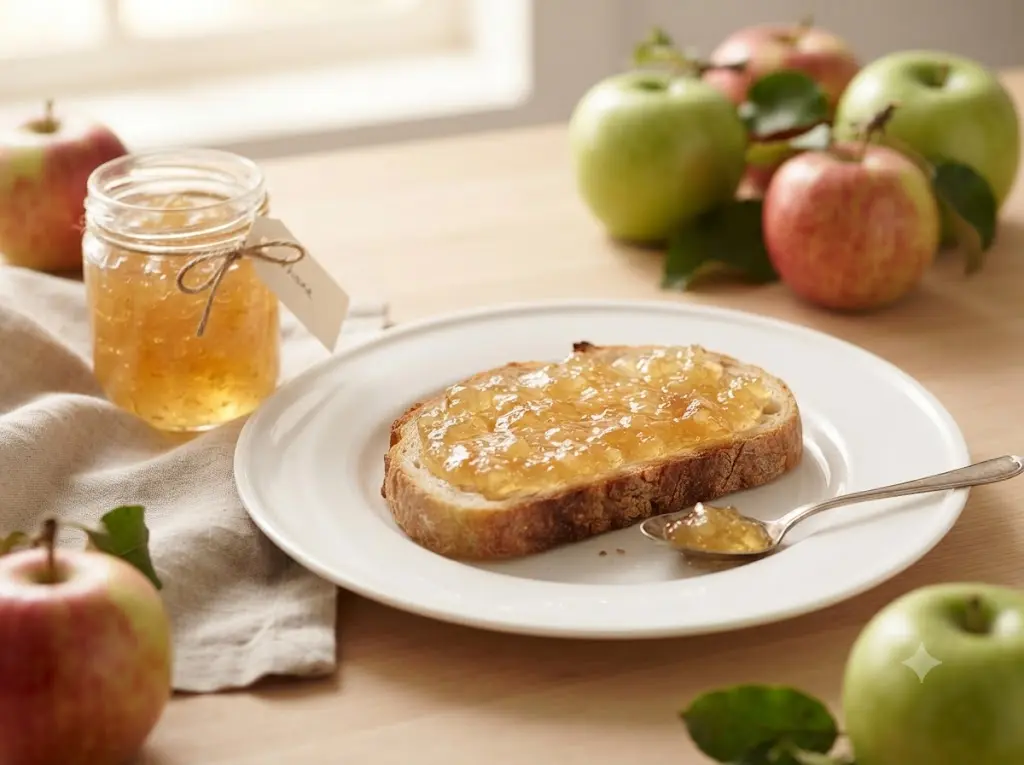
Apple Jelly
Ingredients
Equipment
Method
- Prepare the apples: Wash the apples, remove damaged areas, and cut them into small pieces. Leave the skins and cores on to retain natural pectin.
- Cook the apples: Add the apples and water to a large saucepan. Bring to a boil, then reduce the heat and simmer until the apples are very soft.
- Strain the juice: Transfer the cooked apples to a damp jelly bag or cheesecloth and let the juice drain naturally. Do not squeeze the pulp if you want clear jelly.
- Measure the juice: Measure the strained apple juice before adding sugar. Use about ¾ cup sugar for each 1 cup of apple juice.
- Combine: Add the measured apple juice, sugar, and lemon juice to a clean large pot.
- Bring to a boil: Heat over medium-high to high heat, stirring until the sugar dissolves and the mixture reaches a full boil.
- Cook the jelly: Continue cooking until the mixture reaches the proper jelly stage. At sea level, about 220°F is the usual endpoint for jelly without added pectin.
- Remove foam: Take the pot from the heat and skim away any foam from the surface.
- Fill the jars: Ladle the hot apple jelly into prepared jars, leaving the recommended headspace for canning.
- Process and cool: For shelf-stable storage, process the filled jars using a tested boiling-water-canning method. For refrigerator jelly, cool, cover, and refrigerate.
Notes
- Keep the apple skins and cores on because they contribute natural pectin.
- Do not squeeze the jelly bag if a clear, attractive jelly is your goal.
- Measure the juice first so the sugar amount stays balanced.
- A combination of ripe and slightly underripe apples can provide good flavor and natural pectin.
- Cooking time can vary, so use the jelly endpoint rather than relying only on the clock.
- For shelf-stable storage, follow a tested canning procedure.
Quick Troubleshooting
| Problem | Likely reason | What to do |
|---|---|---|
| Jelly is too soft | It did not reach the proper endpoint | Remake using a tested method |
| Jelly is cloudy | Apple pulp was pressed | Let juice drain naturally |
| Jelly tastes overly sweet | Sugar balance was changed | Measure juice before adding sugar |
| Jelly has weak flavor | Too much water or very mild apples | Use the tested water ratio |
| Jelly did not set | Low pectin or incorrect cooking | Use suitable apples and verify endpoint |
| Jelly has foam | Air and impurities collected during boiling | Skim before filling |
Frequently Asked Questions
Do I need to peel apples for apple jelly?
No. Keep the skins and cores because they contribute natural pectin.
What’s the difference between apple jam and apple jelly?
Apple jam contains fruit pulp, while apple jelly is made from strained fruit juice.
What is the best recipe for apple jelly?
A dependable method uses fresh apples, measured juice, sugar, natural pectin, and the correct jelly endpoint.
What kind of apples are best for apple jelly?
Tart, firm apples with some slightly underripe fruit work well for natural-pectin jelly.
Can I make apple jelly without pectin?
Yes. Apples can provide enough natural pectin when the fruit and cooking method are appropriate.
Why is my apple jelly cloudy?
Pressing the cooked apple pulp can force fine particles into the juice and make the jelly cloudy.
How much sugar should I use for apple jelly?
For this tested method, use about ¾ cup sugar for every 1 cup of strained apple juice.
Can I use apple scraps to make jelly?
Yes, clean peels and cores can contribute natural pectin during juice extraction.
Why didn’t my apple jelly set?
The cause may be insufficient pectin, incorrect sugar or acid balance, excess water, or insufficient cooking.