Go Back
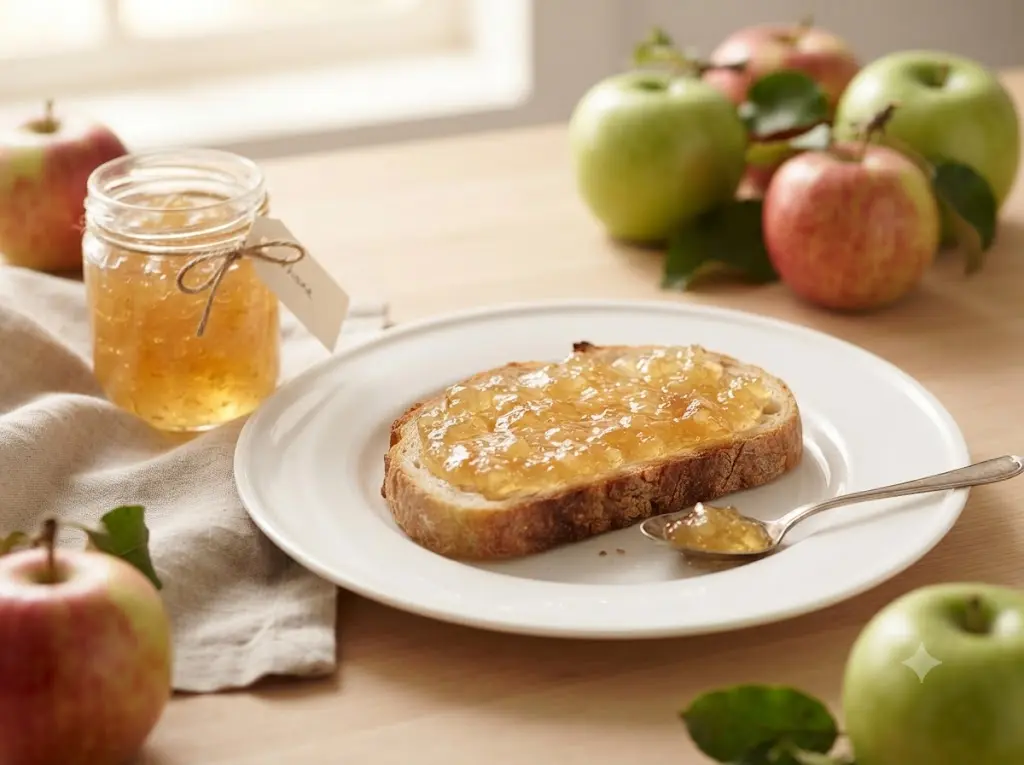
Homemade apple jelly made from fresh apples on toast

Apple Jelly

This apple jelly recipe makes clear, glossy homemade jelly from fresh apples, natural pectin, sugar, and lemon juice. It is an easy traditional method for making apple jelly without adding commercial pectin.
Prep Time 20 minutes
Cook Time 45 minutes
Total Time 1 hour 5 minutes
Servings: 5
Course: Spread
Cuisine: American

Ingredients
  

  • 3 pounds fresh apples preferably a mix of ripe and slightly underripe apples
  • 3 cups water
  • 3 cups granulated sugar
  • 2 tablespoons lemon juice

Equipment

  • Large heavy-bottomed saucepan
  • Sharp kitchen knife
  • Cutting board
  • Jelly bag or several layers of cheesecloth
  • Large bowl
  • Measuring cups
  • Large clean cooking pot
  • Jelly or candy thermometer
  • Ladle
  • Clean half-pint canning jars
  • Boiling-water canner for shelf-stable storage

Method
 

  1. Prepare the apples: Wash the apples, remove damaged areas, and cut them into small pieces. Leave the skins and cores on to retain natural pectin.
  2. Cook the apples: Add the apples and water to a large saucepan. Bring to a boil, then reduce the heat and simmer until the apples are very soft.
  3. Strain the juice: Transfer the cooked apples to a damp jelly bag or cheesecloth and let the juice drain naturally. Do not squeeze the pulp if you want clear jelly.
  4. Measure the juice: Measure the strained apple juice before adding sugar. Use about ¾ cup sugar for each 1 cup of apple juice.
  5. Combine: Add the measured apple juice, sugar, and lemon juice to a clean large pot.
  6. Bring to a boil: Heat over medium-high to high heat, stirring until the sugar dissolves and the mixture reaches a full boil.
  7. Cook the jelly: Continue cooking until the mixture reaches the proper jelly stage. At sea level, about 220°F is the usual endpoint for jelly without added pectin.
  8. Remove foam: Take the pot from the heat and skim away any foam from the surface.
  9. Fill the jars: Ladle the hot apple jelly into prepared jars, leaving the recommended headspace for canning.
  10. Process and cool: For shelf-stable storage, process the filled jars using a tested boiling-water-canning method. For refrigerator jelly, cool, cover, and refrigerate.
Notes

  • Keep the apple skins and cores on because they contribute natural pectin.
  • Do not squeeze the jelly bag if a clear, attractive jelly is your goal.
  • Measure the juice first so the sugar amount stays balanced.
  • A combination of ripe and slightly underripe apples can provide good flavor and natural pectin.
  • Cooking time can vary, so use the jelly endpoint rather than relying only on the clock.
  • For shelf-stable storage, follow a tested canning procedure.