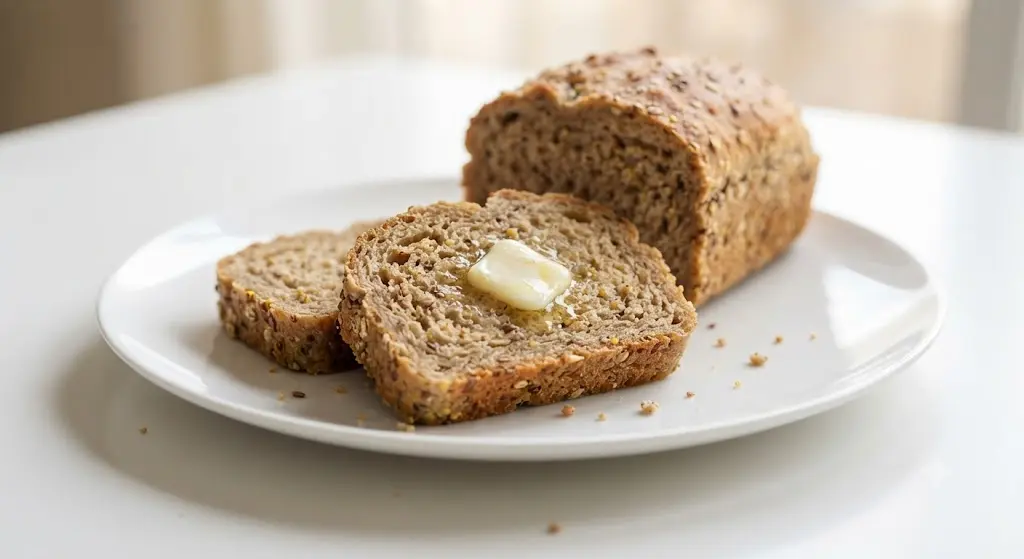
This homemade Ezekiel bread has the hearty texture you expect from a grain-and-legume loaf, but the method is simple enough for a regular home kitchen. It has a nutty flavor, a firm crumb, and makes excellent toast.
What makes this bread different is the combination of grains and legumes. The idea comes from Ezekiel 4:9, where wheat, barley, beans, lentils, millet, and spelt are named together for making bread. The verse gives the ingredients, but it does not give the precise measurements, yeast quantity, or oven temperature used in a modern loaf.
So this is a practical recipe for Ezekiel bread inspired by that passage, not a claim that the original biblical bread followed today’s baking measurements.
The key to getting this loaf right is the dough. It should feel thick and sticky rather than dry and stiff. That one detail makes a big difference to the finished bread.
What Is Ezekiel Bread?
Ezekiel bread is generally associated with a combination of whole grains and legumes, especially wheat, barley, millet, lentils, soybeans, and spelt.
Modern commercial versions can be made quite differently from a homemade recipe. For example, Food for Life’s current Ezekiel 4:9 loaf uses sprouted wheat, barley, millet, lentils, soybeans, spelt, wheat gluten, yeast, and salt.
That explains why homemade versions can vary so much. Some recipes grind dry grains at home, some use sprouted grains, and others use prepared whole-grain flours.
For an easy homemade Ezekiel bread, prepared flours are the most practical place to start.
Why This Homemade Version Works
A loaf made only from whole grains can become heavy if the dough is too dry. Legume flours make the texture even more substantial.
The solution is not to keep adding flour.
Instead, this recipe keeps the dough moist and uses a loaf pan to support the rise. The result is a sliceable loaf with a hearty crumb instead of a brick-like center.
You will notice that the mixture looks more like a thick paste than a classic smooth bread dough. That is normal for this style of bread.
Ingredients
Grain and legume blend
- 2 cups whole-wheat flour
- 1 cup whole-grain spelt flour
- ½ cup barley flour
- ¼ cup millet flour
- ¼ cup lentil flour
- 2 tablespoons soy flour
- 1 tablespoon vital wheat gluten, optional
Wet ingredients
- 1¾ cups warm water
- 2 tablespoons olive oil
- 1 tablespoon honey
For the rise
- 2¼ teaspoons instant yeast
- 1½ teaspoons fine salt
The vital wheat gluten is optional, but it can help the loaf hold together because several of the ingredients do not provide the same gluten-forming ability as wheat.
A Note About the Biblical Ingredients
Ezekiel 4:9 is the reason this bread has its name. The passage names wheat, barley, beans, lentils, millet, and spelt. Different Bible translations use slightly different wording for some ingredients, but the basic list is consistent.
That is also why you may see searches for bible bread recipe, Ezekiel bread recipe Bible, or Pan de Ezequiel.
One important distinction: the Bible passage is not a modern standardized recipe. It does not tell us to use a particular flour ratio, loaf pan, commercial yeast, or oven temperature.
How to Make Homemade Ezekiel Bread
Mix the dry ingredients
Add the whole-wheat flour, spelt flour, barley flour, millet flour, lentil flour, soy flour, vital wheat gluten, yeast, and salt to a large bowl.
Whisk everything thoroughly.
The smaller flours tend to settle into pockets, so give the mixture a proper stir before adding liquid.
Add the wet ingredients
Pour in the warm water, olive oil, and honey.
Stir with a strong wooden spoon or spatula until you have a thick, sticky dough.
Do not try to turn it into a firm kneading dough by adding lots of extra flour.
That is one of the easiest ways to end up with dry Ezekiel bread.
Let the dough rest
Cover the bowl and leave it for about 10 minutes.
During this short rest, the whole-grain flours absorb some of the water. The mixture becomes easier to handle without needing more flour.
Transfer it to the pan
Lightly grease a 9 × 5-inch loaf pan.
Scoop the dough into the pan and smooth the surface with wet fingers or a lightly oiled spatula.
Wet hands work especially well here because the dough can be sticky.
Let it rise
Cover the pan loosely and place it somewhere comfortably warm.
Give it about 60 to 75 minutes.
The dough should look noticeably puffed and approach the top area of the pan. Do not wait for a huge double in size like you might with a light white loaf.
Bake
Preheat the oven to 350°F (175°C).
Bake for 45 to 55 minutes, until the loaf is deeply browned and feels firm through the center.
For a more reliable check, the center should reach roughly 190–200°F (88–93°C).
Cool completely
Leave the bread in the pan for about 10 minutes.
Then transfer it to a cooling rack.
Let it cool before slicing.
This matters with dense whole-grain bread. Cut too early and the steam trapped inside can make the center seem sticky even when the loaf is properly baked.
What the Dough Should Look Like
This is the point where a lot of homemade bread recipes become frustrating.
Your dough may look too wet.
That does not automatically mean it is wrong.
For this recipe, you want:
- Thick rather than runny
- Sticky but manageable
- Soft enough to spread into the loaf pan
- Moist enough that it does not crack while mixing
If the mixture is genuinely liquid, add a tablespoon of whole-wheat flour at a time.
If it is so stiff that stirring becomes difficult, add a small splash of water.
Make changes gradually.
How to Get a Better Loaf Every Time
Do not pack flour into the measuring cup
Scoop and level the flour rather than compressing it.
Too much flour changes the dough considerably.
Do not chase a smooth dough
This is not brioche.
The mixture will remain somewhat rough because of the whole grains and legume ingredients.
Watch the rise, not just the clock
A cool kitchen may need more time.
A warm kitchen may need less.
Give the loaf enough cooling time
The texture continues settling after it comes out of the oven.
A warm slice can make you think the bread has failed when it simply has not finished cooling.
Can You Make Homemade Ezekiel Bread From Scratch?
Yes, and there are two practical ways to do it.
The easiest method is using prepared whole-grain and legume flours, as in this recipe.
The more involved method is buying wheat berries, spelt, barley, millet, and other ingredients and grinding them yourself.
Grinding at home gives you control over the freshness and texture, but it also creates another variable: how finely each ingredient is milled.
That can change how much water the dough needs.
For a first loaf, prepared flours make the process much easier to repeat.
Can You Make Homemade Ezekiel Bread Without Yeast?
Yes, but the answer depends on what you mean by “without yeast.”
A homemade Ezekiel bread without yeast can be made with a sourdough starter instead of commercial yeast. However, sourdough starter itself contains wild yeast, so it is not technically yeast-free.
A completely yeast-free loaf would require a different leavening approach and would have a different texture.
That is why recipes labeled homemade Ezekiel bread no yeast should be checked carefully. “No commercial yeast” and “no yeast at all” are not the same thing.
Sourdough Ezekiel Bread Recipe Variation
For a sourdough version, replace the commercial yeast with an active sourdough starter and give the dough a longer fermentation.
Expect the flavor to become more complex and slightly tangy.
The important part is not to copy the original water amount blindly. A sourdough starter already contains flour and water, so the dough needs to be adjusted according to its hydration.
This variation works best once you are comfortable judging dough consistency rather than relying entirely on a timer.
How to Make an Ezekiel Mix for Bread
Making a dry mix ahead of time is one of the easiest ways to turn this into a genuinely practical weeknight baking recipe.
Combine:
| Ingredient | Amount |
|---|---|
| Whole-wheat flour | 2 cups |
| Spelt flour | 1 cup |
| Barley flour | ½ cup |
| Millet flour | ¼ cup |
| Lentil flour | ¼ cup |
| Soy flour | 2 tablespoons |
| Vital wheat gluten | 1 tablespoon |
Store the blend in an airtight container.
When you are ready to bake, measure the required amount into a mixing bowl and add the yeast, salt, water, oil, and honey.
Label the jar with the ingredients and date so you always know what is inside.
Is Ezekiel Bread Actually Healthy?
It can be a nutrient-dense type of bread because it combines whole grains and legumes, but there is no reason to treat “Ezekiel bread” as automatically healthy regardless of the recipe.
Commercial products can have different ingredient lists and nutrition.
For example, Food for Life’s current Ezekiel 4:9 bread lists sprouted wheat, barley, millet, lentils, soybeans, spelt, wheat gluten, yeast, and sea salt. Its nutrition sheet lists 80 calories, 4 grams of protein, and 3 grams of dietary fiber per 34-gram slice.
Your homemade loaf will not necessarily have those same numbers because the ingredients and serving size are different.
It also contains wheat and soy in this recipe, so it is not suitable for someone avoiding those ingredients.
Dave’s Killer Bread vs Ezekiel Bread
People often ask which is healthier, but the more useful comparison is the actual nutrition label.
For example, Dave’s Killer Bread 21 Whole Grains and Seeds currently lists a 45-gram slice with 110 calories, 6 grams of protein, and 4 grams of fiber.
Food for Life’s Ezekiel 4:9 bread lists a smaller 34-gram serving with 80 calories, 4 grams of protein, and 3 grams of fiber.
That does not make one automatically “better.” The serving weights are different, and the ingredients are different.
For a meaningful comparison, look at the full label and compare equal serving weights or the amount you actually eat.
Storage Tips for Homemade Ezekiel Bread
Homemade bread does not have the same shelf stability as many packaged loaves.
Once completely cool, slice what you expect to use soon and freeze the rest in an airtight freezer bag or container.
Freezing slices individually is especially convenient because you can pull out only what you need for toast or a sandwich.
Avoid sealing the loaf while it is still warm. Trapped steam can make the crust damp and encourage moisture problems during storage.
What to Put on Ezekiel Bread
The dense crumb makes this bread particularly good toasted.
Try:
- Avocado with a soft-boiled egg
- Peanut butter and banana
- Hummus with cucumber
- Cottage cheese and berries
- Turkey with tomato and greens
- Sautéed mushrooms with spinach
- Butter and cinnamon
- Almond butter with sliced apple
The loaf has enough flavor to stand on its own, so simple toppings work very well.
Why This Recipe Is Easier Than It Looks
The ingredient list is long, but the actual process is straightforward.
There is no complicated shaping.
There is no need to create multiple doughs.
There is no need to knead until the dough becomes perfectly smooth.
You mix, rest, transfer, rise, bake, and cool.
The most important skill is learning what the dough should feel like.
Once you recognize that thick, soft consistency, making the next loaf becomes much easier.
Homemade Ezekiel Bread Recipe
Ingredients
Equipment
Method
- Combine the dry ingredients: Add the whole-wheat flour, spelt flour, barley flour, millet flour, lentil flour, soy flour, vital wheat gluten, yeast, and salt to a large bowl. Whisk well so the smaller flours are evenly distributed.
- Add the wet ingredients: Pour in the warm water, olive oil, and honey. Stir until the ingredients form a thick, sticky dough with no visible dry flour.
- Rest the dough: Cover the bowl and let the dough rest for about 10 minutes. This gives the whole-grain flours time to absorb the moisture.
- Mix or knead lightly: Knead the dough gently for about 4–5 minutes, or mix with a dough hook on low speed. Do not keep adding flour to make it smooth; this dough should remain soft and slightly tacky.
- Prepare the loaf pan: Lightly grease a 9 × 5-inch loaf pan with oil.
- Transfer the dough: Scrape the dough into the pan and smooth the surface with wet or lightly oiled fingers. This is much easier than trying to shape it like a regular white-bread dough.
- Let it rise: Cover the pan loosely and leave it in a warm place for about 60–75 minutes, or until the dough looks noticeably puffed.
- Preheat the oven: Heat the oven to 350°F (175°C) while the dough finishes rising.
- Bake the bread: Place the pan in the center of the oven and bake for 45–55 minutes, until the loaf is deeply browned and feels firm through the center.
- Check the center: For a more reliable doneness check, the center should reach approximately 190–200°F (88–93°C).
- Cool before slicing: Leave the loaf in the pan for about 10 minutes, then transfer it to a wire rack. Let it cool substantially before slicing so the crumb can finish setting.
Notes
Baking Tips
The biggest thing I would watch with this homemade Ezekiel bread is the dough consistency. Do not add flour just because the dough feels sticky. The grain and legume flours absorb water differently from ordinary bread flour, and making the dough too dry can leave the finished loaf heavy and crumbly. Use wet fingers when smoothing the dough. It makes the sticky mixture much easier to spread evenly in the loaf pan. Watch the dough instead of relying only on the timer. A cool kitchen can slow the rise, while a warm kitchen can speed it up. Let the bread cool before cutting. A dense whole-grain loaf can look underbaked when it is simply still hot inside. Slice and freeze extra bread. This keeps the remaining loaf easier to use later and makes quick toast convenient.Texture and Flavor
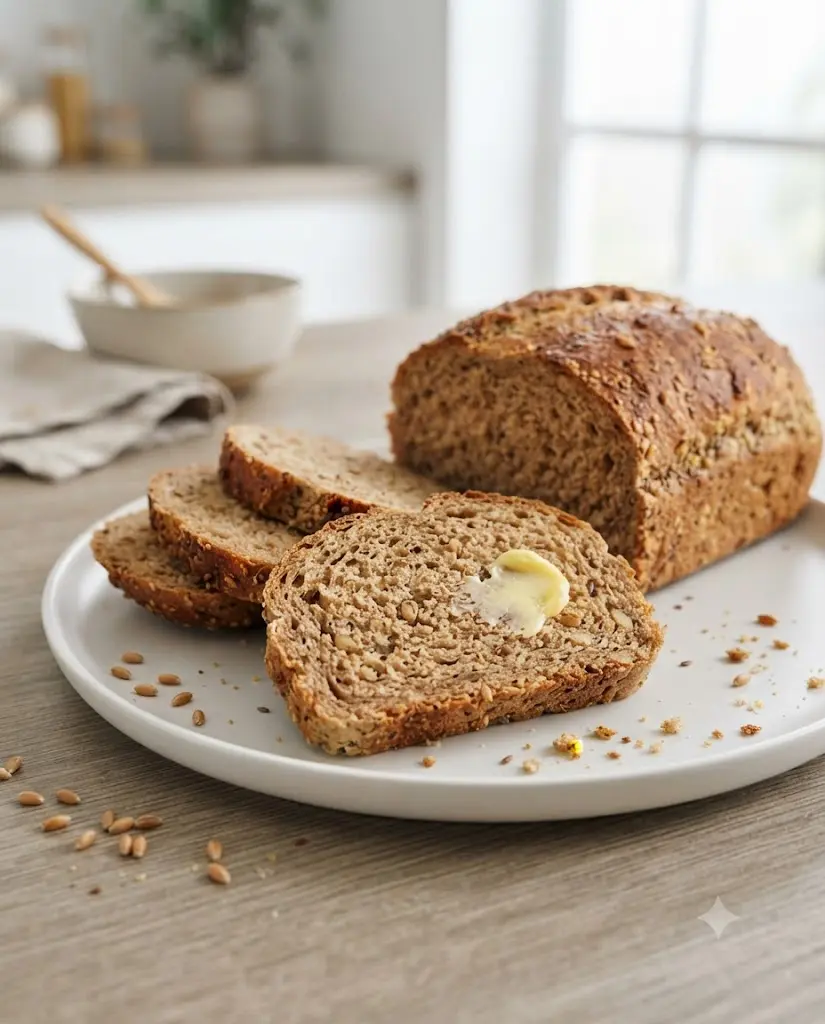
The finished loaf should have a deeply browned crust, hearty grain flavor, slightly nutty notes, and a moist but firm crumb. It will not have the airy texture of a standard white sandwich loaf. That is part of what makes this style of bread distinctive. For the best texture, slice it moderately thin and toast it before adding toppings.Storage
Room temperature: Keep the completely cooled loaf in an airtight bread bag or container and use it within a few days. Refrigerator: Useful when your kitchen is warm, although refrigeration can make bread feel firmer. Freezer: Slice the cooled loaf and freeze the pieces in an airtight freezer-safe bag or container for longer storage.Serving Ideas
- Avocado and egg
- Peanut butter and banana
- Hummus and cucumber
- Cottage cheese and berries
- Turkey, tomato, and greens
- Almond butter and sliced apple
- Butter with cinnamon
Recipe Notes
For a softer crumb: Keep the dough on the moist side rather than adding extra flour. For more grain flavor: Use freshly opened whole-grain flours and toast the finished slices lightly. For a sourdough version: Replace commercial yeast with an active sourdough starter and adjust the hydration according to the starter you use. For a no-commercial-yeast version: Sourdough works, but it is not completely yeast-free because sourdough contains natural yeast.Frequently Asked Questions
Is Ezekiel bread actually healthy?
It can be a nutrient-dense choice, but nutrition depends on the specific recipe, ingredients, portion, and overall diet.
Can Ezekiel bread be made at home?
Yes, a homemade version can be made with whole-grain and legume flours or freshly ground ingredients.
Which is healthier, Dave’s Killer Bread or Ezekiel bread?
Neither is automatically healthier; compare their serving size, ingredients, fiber, protein, sodium, and other nutrition details.
What Bible verse tells us how to make Ezekiel bread?
Ezekiel 4:9 names wheat, barley, beans, lentils, millet, and spelt for making bread.
Can I make homemade Ezekiel bread without yeast?
Yes with a sourdough starter if you mean without commercial yeast, but sourdough still contains natural yeast.
What is the Ezekiel bread recipe Bible reference?
The commonly cited reference is Ezekiel 4:9.
Can I make homemade Ezekiel bread from scratch?
Yes, you can grind the grains yourself or use prepared whole-grain and legume flours.
What is an Ezekiel mix for bread?
It is a pre-measured dry blend of grains and legumes used to make Ezekiel-style bread more conveniently.
Is Pan de Ezequiel the same type of bread?
Yes, “Pan de Ezequiel” is a Spanish term commonly used for Ezekiel bread.
Final Thoughts
The best homemade Ezekiel bread is not the one with the longest ingredient list. It is the loaf that gives you a hearty texture, good flavor, and a method you can confidently repeat.
This recipe for Ezekiel bread keeps the grain-and-legume idea central while using practical ingredients that are easier to find and measure at home.
It also helps to separate the biblical reference from modern baking claims. Ezekiel 4:9 gives the inspiration and ingredient names; modern bakers have developed their own proportions and techniques around that idea.
Whether you are searching for an easy homemade Ezekiel bread, homemade Ezekiel bread from scratch, a sourdough Ezekiel bread recipe, or a homemade Ezekiel bread without yeast, the biggest improvement comes from understanding the dough rather than blindly adding more flour.
Keep it moist, let it rise properly, bake it thoroughly, and allow it to cool before slicing.
That is what gives this hearty bread the texture you want.
1 thought on “Homemade Ezekiel Bread: Easy From-Scratch Recipe”