You do not need self-rising flour or a special baking mix to make good homemade biscuits.
This biscuit recipe with all purpose flour uses simple ingredients and a few important techniques to give you biscuits that are buttery, tender in the middle, and lightly golden on top. The dough comes together quickly, so it is practical for breakfast, brunch, or a simple dinner side.
The part worth paying attention to is the dough.
Cold butter helps create little pockets of richness, while gentle mixing keeps the biscuits from becoming tough. Once you know what the dough should look and feel like, all purpose flour biscuits become much easier to make consistently.
Why All-Purpose Flour Works for Biscuits
All-purpose flour is a convenient middle-ground flour: it provides enough structure for the biscuits to hold their shape without pushing the dough toward the stronger gluten development associated with bread flour.
That matters because biscuits are supposed to be tender, not chewy like bread.
Bread flour can certainly be used in some baking applications, but its higher protein content gives it greater gluten-forming potential. For the soft texture most people expect from homemade biscuits, all-purpose flour is a sensible starting point.
What Makes These Biscuits Light Instead of Heavy?
There are three details that make the biggest difference:
Keep the butter cold. Warm butter can disappear into the flour before the biscuits reach the oven.
Do not overmix the dough. Once the milk is added, stop mixing as soon as you have a shaggy dough.
Use a fully preheated oven. Biscuits need strong heat from the beginning so the dough can rise and set properly.
You do not need to knead the dough. In fact, treating it like bread dough is one of the easiest ways to end up with tough biscuits.
Ingredients You Will Need
| Ingredient | Amount |
|---|---|
| All-purpose flour | 2 cups (240–250 g) |
| Baking powder | 1 tablespoon |
| Granulated sugar | 1 tablespoon |
| Fine salt | 1 teaspoon |
| Unsalted butter, very cold | 6 tablespoons (85 g) |
| Cold whole milk | ¾ cup (180 ml) |
A little melted butter for the tops is optional.
Why Each Ingredient Matters
All-purpose flour gives the dough its structure.
Baking powder provides the main lift.
Sugar adds a subtle sweetness and helps with browning.
Salt keeps the biscuits from tasting flat.
Cold butter adds richness and helps create tender layers.
Milk brings the dough together and gives the finished biscuits a soft interior.
How to Make Biscuits With All Purpose Flour
1. Preheat the Oven
Heat your oven to 425°F (220°C).
Line a baking sheet with parchment paper.
Do this before mixing the dough so the biscuits do not sit around while the oven heats.
2. Combine the Dry Ingredients
Add the flour, baking powder, sugar, and salt to a large bowl.
Whisk them together until evenly combined.
This simple step matters because you want the baking powder and salt distributed throughout the flour rather than concentrated in one area.
3. Add the Cold Butter
Cut the cold butter into small cubes or grate it directly into the flour mixture.
Work it into the flour using a pastry cutter, fork, or your fingertips until you have a coarse, crumbly mixture.
Do not worry about making the mixture perfectly uniform.
Small pieces of butter are useful.
When those pieces heat in the oven, the butter melts into the surrounding dough and helps create a more tender texture.
4. Add the Milk
Pour in the cold milk.
Use a wooden spoon or spatula to mix gently.
Stop when there are no large pockets of dry flour and the dough starts holding together.
It should look somewhat rough.
That is the correct stage.
Do not keep stirring because you want the dough to look smooth.
5. Shape the Dough
Lightly flour the counter and place the dough on it.
Use your hands to gently bring it together.
Pat it into a rectangle roughly ¾ to 1 inch thick.
For more defined layers, fold the dough over itself two or three times, then gently flatten it again.
This should feel more like folding a soft pastry than kneading bread.
6. Cut the Biscuits
Use a round biscuit cutter or the rim of a drinking glass.
Press straight down and lift.
Avoid twisting the cutter.
Place the biscuits on the prepared baking sheet.
For softer sides, arrange them fairly close together. For more edge browning, leave a little space between them.
7. Bake
Bake at 425°F for about 12–15 minutes, or until the tops are lightly golden.
The exact time can vary slightly with biscuit size and your oven.
You are looking for a set center and a lightly browned top rather than a deeply dark crust.
Brush with melted butter while warm, then serve.
What Should Biscuit Dough Feel Like?
This is one of the most useful things to learn when making easy homemade biscuits with all-purpose flour.
The finished dough should be:
- Soft
- Slightly shaggy
- Easy to press together
- Not liquid or runny
- Not stretchy like bread dough
- Slightly tacky but manageable
If it is very sticky, dust the work surface with a little flour.
Do not keep adding flour until the dough feels dry.
A dry dough usually produces a heavier biscuit.
The Cold-Butter Trick
If there is one technique worth remembering, it is this:
Start with cold butter and keep it cold.
For an easier method, you can chill the butter for a short time and grate it into the flour.
This creates small pieces that spread through the dough without requiring a lot of handling.
Another useful visual clue is seeing tiny pieces of butter still visible before baking.
You are not trying to completely blend the butter into the flour like you would when making a cake batter.
Why Your Biscuits May Be Dense
If the biscuits come out flat or heavy, look at the process before changing the entire recipe.
You mixed the dough too much
Long mixing encourages more gluten development.
Next time: Stir only until the dough comes together.
The butter was soft
Soft butter can blend into the flour instead of remaining in small pieces.
Next time: Chill it before starting.
You added too much flour
Extra flour can make the dough stiff.
Next time: Add only the small amount needed to make the dough workable.
Your biscuits were too thin
A thin piece of dough cannot produce the same height as a thicker one.
Next time: Aim for roughly ¾ to 1 inch before cutting.
The oven was not fully hot
Starting in an underheated oven can affect the rise and texture.
Next time: Preheat completely before the tray goes in.
Can You Use Bread Flour Instead?
Yes, but it is not the flour I would choose when the goal is a soft biscuit.
Bread flour typically has more protein than all-purpose flour, which means it can develop a stronger gluten structure. That characteristic is useful in bread, but biscuit dough benefits from a lighter touch.
For most home bakers, all-purpose flour keeps the recipe simple and predictable.
Can You Make a Drop Biscuit Recipe?
Absolutely.
A drop biscuit recipe skips the rolling and cutting.
Make the dough slightly softer, scoop portions onto the baking sheet, and bake until golden.
The result will look more rustic and usually have less defined layers, but the advantage is speed.
There is also less dough handling, which makes drop biscuits particularly convenient when you want something homemade without spending extra time shaping each biscuit.
What About a 3 Ingredient Biscuit Recipe?
A 3 ingredient biscuit recipe can work when the ingredients are designed to perform multiple jobs.
One common shortcut is to use self-rising flour with a rich dairy ingredient. The flour provides both structure and leavening, which is why those recipes can stay very short.
The trade-off is control.
With the recipe above, you can adjust the salt, sugar, butter, and milk independently, which makes it easier to fine-tune the flavor and texture.
Can You Make a 3 Ingredient Biscuit Recipe With All Purpose Flour?
You can simplify the ingredient list, but ordinary all-purpose flour does not contain the baking powder and salt found in self-rising flour.
That means a true three-ingredient formula with regular flour needs another ingredient to provide both lift and enough richness.
For reliable results, a five- or six-ingredient biscuit is usually the easier route.
Milk or Buttermilk?
Both can work.
Whole milk gives the biscuits a mild, familiar flavor and a soft interior.
Buttermilk brings a little more tang and can work especially well in savory biscuits.
For the easiest pantry-friendly version, regular cold milk is enough.
How to Make Biscuits Taller
If tall biscuits are your goal, pay attention to thickness and handling rather than simply adding more baking powder.
Keep the dough fairly thick before cutting.
Do not flatten it repeatedly.
Use a clean, straight downward cut.
And avoid pressing the cutter around the dough several times.
You want to preserve the layers you created while shaping.
Can I Make the Dough Ahead?
Biscuits are best when baked soon after the dough is prepared, but the shaped dough can be chilled briefly before baking.
Keep it covered so the surface does not dry out.
Cold dough can also be helpful because the butter stays firm until the biscuits enter the hot oven.
For longer storage, baked biscuits can be cooled, wrapped well, and frozen.
Best Ways to Serve Homemade Biscuits
Warm biscuits are hard to beat with a little butter.
For breakfast, serve them with eggs, sausage, bacon, jam, honey, or fruit preserves.
For dinner, pair them with soups, stews, roasted chicken, or vegetables.
You can also split them and use them for breakfast sandwiches.
Because the flavor is mild, these biscuits work equally well with sweet and savory toppings.
Quick Baking Checklist
Before putting the tray in the oven, check these five things:
- Butter is still cold.
- Dough is soft rather than dry.
- Dough has not been heavily kneaded.
- Biscuits are around ¾ to 1 inch thick.
- Oven is fully preheated to 425°F.
That short check catches most common biscuit problems before they reach the oven.
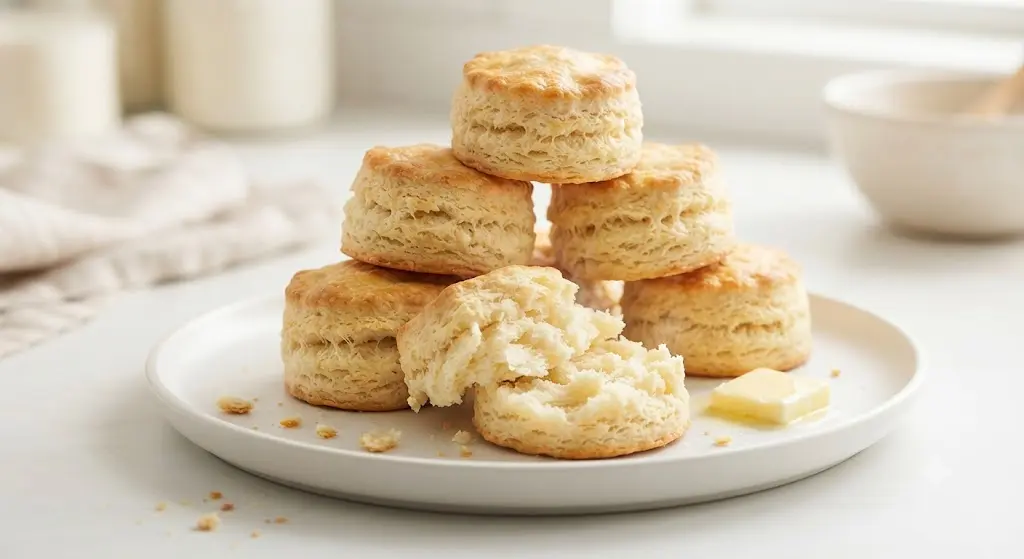
Biscuit Recipe With All Purpose Flour
Ingredients
Equipment
Method
- Preheat the oven: Heat the oven to 425°F (220°C) and line a baking sheet with parchment paper.
- Mix the dry ingredients: Add the all-purpose flour, baking powder, sugar, and salt to a large bowl. Whisk until evenly combined.
- Add the cold butter: Cut the cold butter into small cubes or grate it into the flour. Work it in with a pastry cutter or fingertips until coarse crumbs form with a few small butter pieces still visible.
- Pour in the milk: Add the cold milk and gently stir with a wooden spoon or spatula until a soft, slightly shaggy dough forms. Do not overmix.
- Shape the dough: Transfer the dough to a lightly floured surface and gently press it into a rectangle about ¾ to 1 inch thick.
- Create layers: Fold the dough over itself two or three times, then gently pat it back to the same thickness.
- Cut the biscuits: Press a floured biscuit cutter straight down into the dough and lift without twisting. Place the biscuits on the prepared baking sheet.
- Bake: Bake for 12–15 minutes, or until the tops are lightly golden and the centers are cooked through.
- Finish with butter: Brush the warm biscuit tops with melted butter for a richer finish.
- Serve warm: Let the biscuits rest for a minute or two, then split and serve with butter, honey, jam, or a savory topping.
Notes
Recipe Notes
For taller biscuits: Keep the dough around 1 inch thick before cutting. For softer sides: Place the biscuits close together on the baking sheet. For more golden edges: Leave a little space between each biscuit. For a savory version: Reduce the sugar slightly and add black pepper, herbs, or shredded cheese. For a sweeter serving: Split warm biscuits and add honey, jam, or fruit preserves.Storage
Store completely cooled biscuits in an airtight container at room temperature for up to 2 days. For longer storage, wrap the biscuits well and freeze them. To refresh leftovers, warm them in a 350°F oven for several minutes rather than overheating them in the microwave.Quick Troubleshooting
Biscuits turned out dense: The dough may have been overmixed or too much flour was added. Biscuits spread too much: The butter may have become too warm before baking. Biscuits did not rise well: Check that the baking powder is fresh and that the oven was fully preheated. Dough feels too sticky: Add a small amount of flour to the work surface rather than mixing a large amount into the dough. Biscuits taste flat: Make sure the salt was measured correctly and consider brushing the warm tops with butter.Frequently Asked Questions
What is the simplest biscuit recipe?
Mix all-purpose flour, baking powder, salt, butter, and milk, then gently shape and bake the dough until golden.
Is it better to make biscuits with all-purpose flour or bread flour?
All-purpose flour is generally a better starting point for tender biscuits because bread flour has greater gluten-forming potential.
Can you give me a simple biscuit recipe with only 4 ingredients?
Yes; flour, baking powder, cold butter, and milk can make a simple biscuit, although salt improves the flavor.
What is the secret ingredient for fluffy biscuits?
Cold butter is important, but gentle mixing and a properly hot oven are just as important.
People Also Search For
Simple biscuit recipe with all purpose flour
This recipe keeps the ingredient list simple while using regular all-purpose flour.
3 ingredient biscuit recipe
Three-ingredient versions are possible, especially when using self-rising flour and a rich dairy ingredient.
3 ingredient biscuit recipe with all purpose flour
Regular all-purpose flour usually needs separate leavening and seasoning, so a slightly longer ingredient list is more dependable.
Best biscuit recipe with all purpose flour
Look for a recipe with clear measurements, cold fat, gentle mixing, and a properly heated oven.
Best biscuit recipes
The right recipe depends on whether you prefer flaky cut biscuits, quick drop biscuits, or richer buttermilk-style biscuits.
3 ingredient biscuit recipe with milk
Milk can be used in simplified biscuit recipes, although butter or another fat is usually needed for a tender result.
Biscuits recipe
This version is designed for everyday homemade biscuits using regular all-purpose flour.
Drop biscuit recipe
Drop biscuits are a quick alternative because you can scoop the dough directly onto the baking sheet without cutting it.
Final Thoughts
A good biscuit recipe with all purpose flour does not need complicated ingredients.
The real difference comes from small details: cold butter, a light hand, enough dough thickness, and a properly heated oven.
Once you learn to recognize the dough rather than relying only on a timer or a picture, homemade biscuits become much easier to repeat.
That is also the key to making easy homemade biscuits with all-purpose flour without turning the process into a project.
Keep the butter cold.
Do not overwork the dough.
Bake it while the oven is hot.
Those three habits will take you a long way toward soft, fluffy all purpose flour biscuits every time you make them.