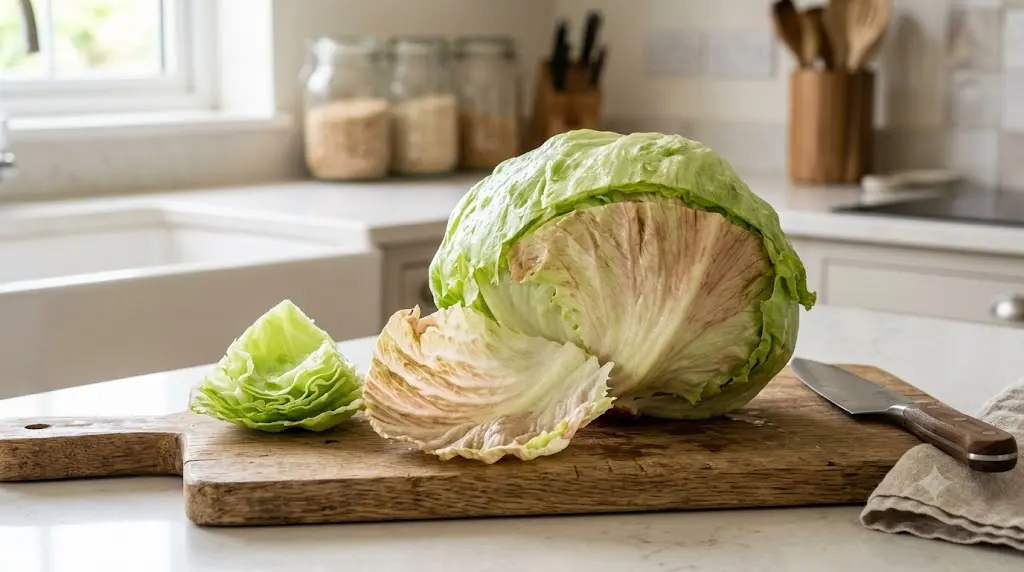
You cut into a head of lettuce for a salad, come back to it later, and suddenly the edges look pink.
That can be a little alarming the first time you see it.
So, why is my lettuce pink? And more importantly, is pink lettuce safe to eat?
In many cases, a pink or reddish color is a natural quality change called pink rib or pinking. It can happen in lettuce after storage, with overmature heads, or after the leaves have been cut or damaged. UC Davis specifically describes pink or reddish discoloration of lettuce ribs as a postharvest physiological disorder.
But there is an important catch: pink color by itself does not tell you whether lettuce is safe.
You need to check the lettuce as a whole.
Lettuce Turning Pink: The Quick Answer
If your lettuce has a small pink or reddish area but is still crisp, fresh-smelling, and free from slime or mold, the color may simply be a discoloration issue.
If it is slimy, mushy, moldy, foul-smelling, or visibly decomposing, throw it away.
And there is one more thing to remember: food can contain harmful pathogens without looking or smelling spoiled. That is why proper refrigeration and safe handling still matter.
Why Is My Lettuce Pink?
There is not just one reason.
One common explanation is pink rib, a natural postharvest change in lettuce. The midrib or base of the leaf can develop a pink to reddish color, especially when lettuce has been stored for a while, harvested at a more mature stage, or kept at temperatures higher than recommended.
Cutting and bruising can also trigger discoloration.
When lettuce tissue is injured, its chemistry changes and pink or brown areas can develop. UC Davis notes that mechanical injury can lead to injury-induced discoloration and can also make the lettuce more susceptible to decay.
So, when you see pink on lettuce, look at where the color is appearing.
A narrow pink area around a rib or cut surface is a different situation from a whole leaf becoming wet, soft, and deteriorated.
Why Does Lettuce Turn Red?
People often search why does lettuce turn red because the color is not always exactly pink.
Depending on the lettuce and the stage of discoloration, you may see:
- Pale pink
- Pinkish-red ribs
- Red edges
- Brownish-red areas
- Pink-brown patches
The color change can be associated with natural postharvest reactions and physical injury. UC Davis identifies pink rib as a physiological disorder and also notes pink/brown discoloration associated with mechanical damage.
That means lettuce turning red does not automatically equal rotten lettuce.
The texture and condition still matter.
Is Pink Lettuce Safe to Eat?
This is the part most people really want to know.
Pink but still fresh
If the lettuce is:
- Crisp or reasonably firm
- Free of slime
- Free of mold
- Free of a strong unpleasant odor
- Otherwise fresh-looking
then pinking may be a quality problem rather than obvious spoilage.
Pink and deteriorating
Be much more cautious when the color comes with:
- Slime
- Mushiness
- Wet, collapsing tissue
- Mold
- A sour, rotten, or unpleasant smell
- Widespread decay
FDA information on lettuce identifies soft, slimy decay as a serious spoilage condition.
So the answer to is pink lettuce safe to eat is not simply yes or no.
A pink color needs context.
Lettuce Turning Pink Safe to Eat? Use This Check
When you are holding the lettuce in your kitchen, this quick check is more useful than guessing from the color.
| What you see | What it means |
|---|---|
| Small pink area on the rib | May be natural pinking |
| Slight pinking after cutting | Can happen from tissue injury |
| Crisp leaves | Good sign for freshness |
| Mild or normal smell | Better sign |
| Slimy leaves | Throw it away |
| Mold | Throw it away |
| Strong unpleasant odor | Throw it away |
| Mushy, breaking-down leaves | Throw it away |
This does not replace food-safety guidance, but it helps separate a simple discoloration issue from obvious spoilage.
Lettuce Turning Pink in Fridge
If you specifically noticed lettuce turning pink in the fridge, that timing makes sense.
Lettuce continues to change after harvest. Storage slows those changes, but it does not stop them completely.
Pink rib and other discoloration problems can become more noticeable during storage. UC Davis notes that prolonged storage and higher-than-recommended temperatures can increase pink rib, while physical damage can also lead to pinking.
Your refrigerator should be 40°F (4°C) or below for perishable fresh produce such as lettuce, according to FDA guidance. Pre-cut and packaged produce should also be refrigerated.
So if your lettuce is pink after several days in the refrigerator, do not immediately assume it is spoiled.
Check the rest of the leaf.
Iceberg Lettuce Turning Pink
Iceberg lettuce turning pink is especially easy to notice because the inside of an iceberg head is so pale.
The ribs and base can develop pink or reddish discoloration, and UC Davis specifically documents pink rib in iceberg lettuce. It is generally associated with postharvest conditions such as overmaturity, prolonged storage, or unsuitable storage temperatures.
There is also another common situation with iceberg lettuce: the leaves are cut for salads, and damaged cut surfaces begin to discolor.
So if an iceberg head has a little pink along the rib but remains firm and fresh, that is not the same thing as a head that has become slimy and rotten.
What About Lettuce Turning Red Safe to Eat?
The same basic rule applies to lettuce turning red safe to eat.
Red or pink discoloration alone is not enough to make the call.
Look for the combination of symptoms.
Color change only: may be a quality issue.
Color + slime: discard.
Color + mold: discard.
Color + strong odor: discard.
Color + extensive soft decay: discard.
This distinction matters because spoilage and natural discoloration are not the same thing.
How to Know If Lettuce Has Gone Bad
When lettuce is actually going bad, you will usually notice a change in more than color.
Slimy leaves
A slippery, slimy surface is one of the clearest warning signs.
Soft or mushy texture
Fresh lettuce should have structure. Leaves that are collapsing and breaking down are past their best.
Bad smell
A strong unpleasant smell is a good reason not to eat it.
Mold
If you see mold, the safest choice is to discard the lettuce. FDA advises throwing away moldy food rather than trying to treat the mold as harmless.
Water-soaked decay
Wet, translucent, soft areas can progress into decay. FDA describes bacterial soft rot of lettuce as tissue that becomes soft and slimy as the decay advances.
When Should Lettuce Not Be Eaten?
I would not try to save lettuce that has obvious spoilage signs.
That includes lettuce that is:
- Moldy
- Slimy
- Strongly foul-smelling
- Heavily decomposed
- Very soft and breaking down
Also pay attention to storage history.
FDA recommends keeping perishable fresh vegetables such as lettuce refrigerated at 40°F or below.
And if a particular lettuce product is subject to a recall, follow the recall instructions instead of judging the product by color or smell.
One Thing Pink Lettuce Cannot Tell You
This is an easy point to miss.
You cannot look at lettuce and know with certainty that it is free from harmful bacteria or other pathogens.
FDA notes that food can make someone sick even when it does not look, smell, or taste spoiled. Proper refrigeration and hygienic food handling reduce risk but do not turn appearance into a safety test.
So when you ask, “Is this pink lettuce safe to eat?” there are really two questions:
Is the pink color itself a normal lettuce change?
It can be.
Does that prove the lettuce is microbiologically safe?
No.
That distinction is worth remembering.
Pink on Lettuce After Cutting
Have you ever cut lettuce for lunch and noticed that the cut side looks different the next day?
That is common enough to be worth explaining.
Cutting damages the plant tissue. UC Davis notes that pinking and browning can occur in damaged lettuce as part of injury-related phenolic metabolism.
In plain English, the cut surface is no longer protected in the same way as an intact leaf.
That is one reason fresh-cut lettuce can change appearance faster than a whole head.
Pink Lettuce in Salad Kit
Seeing pink lettuce in a salad kit deserves a little more attention because the lettuce has already been cut and packaged.
Start with the package.
Check:
- The use-by or best-by information
- Whether the bag is damaged or unusually swollen
- Whether the greens look wet or slimy
- Whether there is an unpleasant odor
- Whether the package has been kept cold
Pre-cut and packaged produce should be refrigerated, and FDA recommends keeping perishable produce such as lettuce at 40°F or below.
Do not assume a salad kit is safe simply because the bag looks normal. Pathogens do not always produce an obvious visual change.
Does Lettuce Last Longer in a Bag or a Container?
There is no single winner.
The bigger issue is moisture, temperature, and handling.
A whole head can be kept in a produce bag or similar protective packaging. For cut lettuce, a clean container can be convenient.
The mistake to avoid is leaving the leaves sitting wet.
Lettuce loses water after harvest, and UC Davis notes that a barrier such as a thin plastic bag can help reduce water loss and preserve appearance.
For cut lettuce, keep it cold and avoid unnecessary handling.
If you wash it before storage, drying the leaves well can also help prevent excess moisture from building up around them.
How to Keep Lettuce Fresh Longer
You cannot stop lettuce from aging, but a few habits help.
Keep it cold
Your refrigerator should be at 40°F or below for perishable produce.
Handle it gently
Bruising and cuts can speed up discoloration and deterioration.
Do not leave washed leaves soaking wet
Excess moisture makes storage harder.
Keep the head intact when possible
An intact head has less exposed cut surface than chopped lettuce.
Use older lettuce first
That simple habit saves more food than constantly trying new storage tricks.
Can You Cut Off the Pink Part?
Sometimes people simply remove the pink section and continue with the rest.
That can improve the appearance when the issue is limited discoloration on an otherwise fresh head.
But trimming is not a fix for spoilage.
Do not use a knife to “save” lettuce that is slimy, moldy, foul-smelling, or broadly decomposing.
A small cosmetic discoloration and widespread decay are two very different situations.
Pink Romaine Lettuce: Natural Variety or Discoloration?
The phrase pink romaine lettuce can be confusing.
It can describe a naturally colored lettuce variety, or it can describe regular green romaine that has developed pink or reddish discoloration.
Those are not the same thing.
If the lettuce was sold as a pink-, red-, or burgundy-leaf variety, its natural color is part of the cultivar.
If ordinary green romaine develops pink ribs after storage, you are more likely looking at postharvest discoloration.
So before judging it, think back to what the lettuce looked like when you bought it.
What Are Pink Lettuce Seeds?
If you searched pink lettuce seeds, you may actually be looking for a lettuce variety that naturally produces pink, red, burgundy, or reddish leaves.
That is completely different from a normal green lettuce head that starts changing color in your refrigerator.
When buying seeds, check the actual variety description rather than relying only on the phrase “pink lettuce.” Leaf color, maturity time, growing conditions, and final size can vary considerably between varieties.
What Is Pink Lettuce Price?
If you searched pink lettuce price, you may notice that prices vary a lot.
That is because “pink lettuce” can refer to different things, including fresh specialty lettuce, a specific cultivar, or packets of seeds.
Price depends on:
- Variety
- Fresh lettuce vs. seeds
- Pack size
- Organic or conventional production
- Season
- Local availability
- Retailer
So there is no single standard price for pink lettuce.
Pink Lettuce vs. Bad Lettuce
Here is the easiest way I remember the difference:
| Pink lettuce | Bad lettuce |
|---|---|
| Pink/red discoloration may be limited to ribs or damaged tissue | Decay is usually more obvious |
| May still be crisp | Often soft or mushy |
| May smell normal | Often develops an unpleasant odor |
| No slime | Slime is a warning sign |
| No mold | Visible mold means discard |
There can be exceptions, so do not treat this as a laboratory test.
Think of it as a practical kitchen check.
What I Would Check First
When I see pink lettuce, I would not make the decision from color alone.
I would check the texture first.
Then I would smell it.
Then I would look closely for slime, mold, or areas that are actually breaking down.
Finally, I would think about how it was stored.
That takes less than a minute and gives you much more information than simply asking whether “pink” means bad.
Frequently Asked Questions
Is lettuce safe to eat if it turns red?
Not necessarily unsafe, and not automatically safe either. Red or pink discoloration can come from postharvest changes such as pink rib or injury-related discoloration. Check the lettuce for spoilage signs such as slime, mold, unpleasant odor, and significant decay.
Does lettuce last longer in a bag or a container?
Both can work. For a whole head, a protective produce bag can help reduce water loss. For cut lettuce, a clean container can be convenient. Keeping the lettuce cold and managing excess moisture are more important than choosing one storage method universally.
How do I know if lettuce has gone bad?
Look for slimy leaves, mold, strong unpleasant odors, mushy tissue, and visible decay. Wilting alone does not necessarily mean spoilage, but wilting combined with slime or deterioration is more concerning.
When should lettuce not be eaten?
Discard lettuce when it has mold, significant slime, a strong unpleasant smell, or extensive decomposition. Also follow the instructions for any applicable recall.
Why does lettuce turn pink?
Lettuce can develop pink or reddish discoloration because of postharvest physiological changes, prolonged storage, maturity, or physical injury. Pink rib is a recognized lettuce disorder.
Is lettuce turning pink in the fridge normal?
It can happen during storage. Pink rib and injury-related discoloration may become visible while lettuce is refrigerated. Keep lettuce properly chilled and judge freshness from the overall condition of the leaves, not color alone.
Is pink lettuce safe to eat after cutting?
A small amount of pinking after cutting can be a natural discoloration process. However, cut lettuce still needs proper refrigeration and handling, and any slime, mold, bad odor, or obvious decay is a reason to discard it.
Why is my iceberg lettuce pink?
Iceberg lettuce can develop pink or reddish discoloration in the ribs or damaged areas. UC Davis specifically lists pink rib as a postharvest disorder of crisphead/iceberg lettuce.
Can lettuce turn red without being spoiled?
Yes. Natural postharvest discoloration can produce pink or reddish areas without being the same thing as spoilage. Still, color alone cannot establish food safety.
What should I do if there is pink lettuce in a salad kit?
Check the package condition, date information, smell, texture, and storage history. If the greens are slimy, moldy, badly deteriorated, or involved in a recall, do not eat them. Packaged cut lettuce should stay refrigerated.
Final Answer: Should You Throw Away Pink Lettuce?
Not just because it is pink.
Pink or red discoloration can be a normal postharvest change in lettuce, especially around ribs, damaged areas, or after storage.
But do not use that fact as a guarantee that the lettuce is safe.
Check the whole leaf.
If it is still reasonably crisp, smells fresh, and has no mold or slime, the pink color may simply be discoloration.
If it is slimy, mushy, moldy, foul-smelling, or visibly decomposing, throw it away.
And remember the bigger food-safety point: harmful pathogens are not always visible or detectable by smell. Proper refrigeration and handling still matter even when lettuce looks perfectly normal.
So the next time you see lettuce turning pink, do not panic—and do not automatically eat it either.
Look at the whole lettuce, not just the color.